
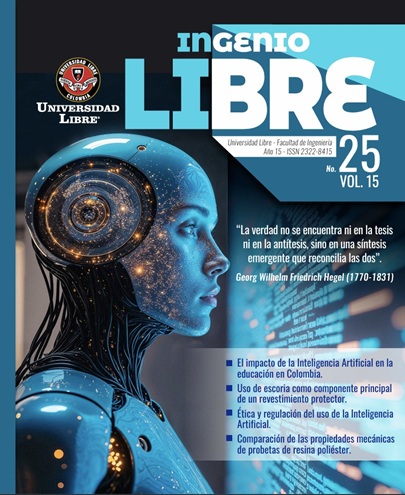
USO DE ESCORIA COMO COMPONENTE PRINCIPAL DE UN REVESTIMIENTO PROTECTOR: UNA REVISIÓN BIBLIOGRÁFICA
Palavras-chave:
Recubrimientos de escoria, pinturas industriales a base de escoria, Cerámicas de escoria, Slag splashingResumo
Esta revisión analiza el estado actual del uso de la escoria en la fabricación de recubrimientos, destacando su potencial como material protector. Un proceso clave en su desarrollo es el slag splashing, utilizado en la industria siderúrgica para recubrir los hornos con escoria fundida, reduciendo el desgaste y prolongando la vida útil de los equipos. Este método ha servido de base para investigaciones que buscan optimizar la composición y propiedades de la escoria en aplicaciones de recubrimiento. La escoria se emplea en recubrimientos industriales innovadores, como pinturas y recubri
mientos cerámicos, destacando por su resistencia y estabilidad térmica. Además, su uso en cementos, concretos e infraestructura vial impulsa la economía circular, reduciendo desechos industriales y fomentando materiales más sostenibles.
Downloads
Referências
[1]
World Steel Association, “December 2021
crude steel production and 2021 global
totals,” World Steel Association, 2022.
[Online]. Available: https://worldsteel.org/
media/pressreleases/2022/december
2021crudesteel-production-and-2021
globaltotals.
[2] A. Shahbaz, N. Mallick, y T. Loganathan,
“Does globalization impede environmental
quality in developed economies? An
application of the dynamic ARDL
simulations approach,” Environ Dev
Sustain, vol. 20, no. 4, pp. 1779–1801, ago.
2018. doi: 10.1007/s10668-016-9759-x.
[3] L. Sofia, M. Josef, C. Ivan, y K. Jurate,
“Leaching Behaviour of Copper Slag,
Construction and Demolition Waste and
Crushed Rock Used in a Full Scale Road
Construction,” Journal of Environmental
Management, vol. 204, pp. 695-703, 2017.
[4] J. Yi, L. Tung-Chai, S. Caijun, P. Shu Yuan,
Characteristics of Steel Slags and Their
Use in Cement and Concrete-A Review,
Resources, Conservation and Recycling
(2018), pp. 187-197.
[5] S. Mohammad, B. Kiachehr, M. Reza,
Application of alkali-activated slag concrete
in railway sleepers, Materials and Design, 69
(2015), pp. 89-95.
[6] Takahashi, Tatsuhito & Yabuta, Kazuya.
(2002). New Applications for Iron and
Steelmaking Slag. NKK Technical Review.
[7] S. Das, J. G. Lee, S. R. Cho, H. J. Song, y P.
J. Kim, “Cropping With Slag to Address Soil,
Environment, and Food Security,” Front.
Microbiol., vol. 10, p. 1320, jun. 2019. doi:
10.3389/fmicb.2019.01320.
[8] A.M. Torkashvand and S. Sedaghathoor,
“Converter slag as a liming agent in the
amelioration of acidic soils,” International
Journal of Agriculture & Biology, vol.
9, no. 5, pp. 715-720, 2007. [Online].
Available: https://www.researchgate.net/
publication/228663048_Converter_slag_
as_a_liming_agent_in_the_amelioration_
of_acid ic_soils
[9] J. Chen, Y. Xing, Y. Wang, W. Zhang, Z. Guo,
y W. Su, “Application of iron and steel slags
in mitigating greenhouse gas emissions: A
review,” Sci. Total Environ., vol. 844, p. 157041,
2022. doi: 10.1016/j.scitotenv.2022.157041.
[10] I. H. Aziz, M. M. A. B. Abdullah, M. A. A. M.
Salleh, L. Y. Ming, L. Y. Li, A. V. Sandu, P.
Vizureanu, O. Nemes, y S. N. Mahdi, “Recent
Developments in Steelmaking Industry
and Potential Alkali Activated Based Steel
Waste: A Comprehensive Review,” Materials
(Basel), vol. 15, no. 5, p. 1948, 2022. doi:
10.3390/ma15051948.
[11] C. Solanki, “Utilization of Steel Slag for
Wastewater Treatment: A Review,” en
Sustainable Building Materials and
Construction, B. Kondraivendhan, C. D.
Modhera, y V. Matsagar, Eds. Singapore:
Springer Singapore, 2022, pp. [páginas del
capítulo], doi: 10.1007/978-981-168496-8_50.
[12] M. Oge, D. Ozkan, M. B. Celik, M. S. Gok, y
A. C. Karaoglanli, “An Overview of Utilization
of Blast Furnace and Steelmaking Slag in
Various Applications,” Mater. Today Proc.,
vol. 11, no. 1, pp. 516–525, 2019. doi: 10.1016/j.
matpr.2019.01.023. [13] OEC, “slag and ash
n.e.c. in chapter 26,” [Online]. Available:
https://oec.world/en/profile/hs/otherslag
and-ash.
[14] J. Zhang, H. Matsuura, y F. Tsukihashi,
“Processes for Recycling,” 2014. doi: 10.1016/
B978-0-08-096988-6.00036-5.
[15] World Steel Association, “About Steel, how
steel is made?” [Online]. Available: https://
worldsteel.org/aboutsteel/about-steel/.
[16] N. M. Piatak, M. B. Parsons, y R. R. Seal,
“Characteristics and environmental
aspects of slag: A review,” Appl. Geochem.,
vol. 57, pp. 236–266, 2015. doi: 10.1016/j.
apgeochem.2014.04.009.
[17] ScienceDirect, “The mineralogical
composition of slags from gray iron
production,” Constr. Build. Mater. [Online].
Available: https://www.sciencedirect.com/
science/ article/pii/S0959652619309035.
[18] ScienceDirect,
“Properties
of slags
in metallurgical processes,” Minerals
Eng. [Online]. Available: https://www.
sciencedirect.com/science/ article/pii/
S0892687519301442.
[19] SpringerLink, “Non-ferrous and ferrous
slags: Environmental insights,” J. Environ.
Sci. [Online]. Available: https://link.springer.
com/article/10.1007 /s40831-018-0182-0.
[20] ScienceDirect, “Recycling and valorization
of ferrous and non-ferrous slags,” J. Sustain.
Mater. [Online]. Available: https://www.
S0956053X20301600.
[21] Springer, Technological advances in slag
reutilization, Advances in Environmental
Technology, 2019. [Online]. Available:
https://www.springer.com/gp/book/9783
319513734.
[22] X. Zhang, J. Chen, J. Jiang, J. Li, R. D. Tyagi, y
R. Y. Surampalli, “The potential utilization of
slag generated from iron- and steelmaking
industries: a review,” Environ. Geochem.
Health, vol. 42, no. 5, pp. 1321–1334, 2020. doi:
10.1007/s10653-019-00419-y.
[23] Universidad Nacional de Colombia, “Informe
experimental: Laboratorio Interfacultades
de Fluorescencia de Rayos X,” Sede Bogotá,
Bogotá D.C., Colombia, mayo 05 de 2022,
código [BDL-XRF-065-2022].
[24] ScienceDirect, “Copper slag valorization:
Environmental and industrial insights,”
J. Cleaner Prod. [Online]. Available:
https://www.sciencedirect.com/science/
article/abs/pii/S0892687519301442. [25]
SpringerLink, “Mineralogical and chemical
properties of non-ferrous slags,” Miner.
Process. Extr. Metall. [Online]. Available:
https://link.springer.com/article/10.1007 /
s40831-018-0182-0.
[26] ScienceDirect, “Recycling and reuse of
zinc slags in construction,” Resources,
Conservation and Recycling. [Online].
[27] SpringerLink, “Advances in lead smelting
slag management,” J. Sustain. Metall.
[Online]. Available: https://www.springer.
com/article/10.100 7/s40831-018-0182-0.
[28] Revista de Metalurgia, “Caracterización de
escorias de fundición de cobre,” Rev. Metal.,
vol. 55, no. 1, pp. 45–59, 2020. [Online]. Available:
https://revistademetalurgia.revistas.csic. es.
[29] ScienceDirect, “Environmental benefits
of non-ferrous slag reuse,” J. Environ.
Manage. [Online]. Available: https://www.
sciencedirect.com/science/article/pii/
S0959652619309035.
[30] Springer, Advances in slag recycling
technologies, Advances in Sustainable
Metallurgy, 2018. [Online]. Available:
[31] ScienceDirect, “Characterization and reuse
of non-ferrous slags in construction,” J.
Hazard. Mater. [Online]. Available: https://
www.sciencedirect.com/science/ article/pii/
[32] K. Mills, Y. Su, A. Fox, Z. Li, R. Thackray, y
H. Tsai, “A Review of Slag Splashing,” ISIJ
Int., vol. 45, pp. 619–633, 2005. doi: 10.2355/
isijinternational.45.619.
[33] A. Makwana, A. Sane, X. He, y G. Buragino,
“Novel Method for Stirring BOF Melts in
Conjunction with Slag Splashing,” Air
Products, Allentown, PA, US, Informe
Técnico 335-20-001US, [En línea]. Disponible:
https://www.airproducts.com//media/files/
en/335/335-20-001-usnovel-method-for
stirring-bofmelts.pdf.
[34] B. Tang et al., “IOP Conf. Ser.: Earth Environ.
Sci.”, vol. 199, p. 042054, 2018.
[35] M. Barron, D. Medina, y I. Hilerio, “CFD
Analysis of Influence of Slag Viscosity
on the Splashing Process in an Oxygen
Steelmaking Converter,” Modeling and
Numerical Simulation of Material Science,
vol. 3, no. 3, pp. 90–93, 2013. doi: 10.4236/
mnsms.2013.33012.
[36] Z. Liu, B. Blanpain, y M. Guo, “Viscosity of
Partially Crystallized BOF Slag,” 2016. doi:
10.1007/978-3-31948093-0_33.
[37] Z. Yuan, Y. Wu, H. Zhao, H. Matsuura, y F.
Tsukihashi, “Wettability Between Molten
Slag and MgO–C Refractories for the Slag
Splashing Process,” ISIJ Int., vol. 53, p. 598,
2013. doi: 10.2355/isijinternational.53.598.
[38] H. Tsai, L. Dong, L. Li, B. Song, y W. Chen,
“Proc. Asia Steel Int. Conf.,” Chinese Society
for Metals, Beijing, 2000, p. 170.
[39] G. Chen y S. He, “Effect of MgO content in
slag on dephosphorisation in converter
steelmaking,” Ironmaking Steelmaking, vol.
42, pp. 433–438, 2014. doi: 10.1179/1743281214
Y.0000000246.
[40] S. Devi, “Optimization of Slag Chemistry for
Slag Splashing to Increase Converter Lining
Life,” Steel and Metallurgy, vol. 16, pp. 4–12,
2014.
[41] R. R. Yin et al., “The study on the interface
reaction characteristics of different binary
slag, CaO – MgO, Al2O3 – CaO, Al2O3 – MgO,
SiO2 – CaO, SiO2 - MgO,” Metalurgija, vol. 58,
no. 1-2, pp. 15–18, 2019.
[42] H. Tsai, L. Dong, L. Li, B. Song, y W. Chen,
[43] H. Binici y O. Aksogan, “The use of ground
blast furnace slag, chrome slag and corn
stem ash mixture as a coating against
corrosion,” Constr. Build. Mater., vol. 25,
no. 11, pp. 4197–4201, 2011. doi: 10.1016/j.
conbuildmat.2011.04.057.
[44] Y. Kucuk et al., “Ferrochromium slag as
a
protective coating material against
oxidation for caster rolls,” Int. J. Appl. Ceram.
Technol., vol. 15, pp. 1240–1247, 2018.
doi:
10.1111/ijac.12875.
[45] P. Pati, M. Satpathy, y A. Satapathy,
“Erosion Wear Response of Linz Donawitz
Slag Coatings: Parametric Appraisal and
Prediction Using Imperialist Competitive
Algorithm and Neural Computation,” SAE
Int. J. Mater. Manuf., vol. 12, no. 2, pp. 95–106,
2019. doi: 10.4271/05-12-02-0008.
[46] A. Majumdar y S. Jana, “Glass and Glass
Ceramic Coatings:
Versatile Materials
for Industrial and Engineering Applications,”
Bulletin of Materials Science, vol. 24, no. 1, pp.
69-77, 2001. [47] T. E. Saraswati, K. Nugroho,
y M. Anwar, “An Anticorrosion Coating from
Ball-milled Wood Charcoal and Titanium
Dioxide Using a Flame Spray Method,” Int.
J. Technol., vol. 9, no. 5, pp. 983–992, 2018.
[48] T. Sowmya y S.R. Sankaranarayanan,
“Spectroscopic Analysis of Slags Preliminary
Observations,” in II International Conference
on Molten Slags Fluxes and Salts, The South
African Institute of Mining and Metallurgy,
South Africa, 2004, pp. 693–697.
[49] M. Oge, A. C. Karaoglanli, y M. B. Celik,
“Room and high temperature wear
behaviors of steelmaking slag coating and
WC reinforced composite coatings,” Surf.
Coat. Technol., vol. 399, p. 126162, 2020. d o i :
10.1016/j.surfcoat.2020.126162.
[50] P. Liu, W. Lianqi, X. Zhou, Y. Shufeng, y Y.
Chen, “A glass-based protective coating
on stainless steel for slab reheating
application,” J. Coat. Technol. Res., vol. 8, pp.
149–152, 2011. doi: 10.1007/s11998-010-9302-1.
[51] L. Aries, “Preparation of electrolytic ceramic
films on stainless steel conversion coatings,”
J. Appl. Electrochem., 1994. doi: 10.1007/
BF00249857.
[52] G. Sycheva, “Volume and Surface Nucleation
of Crystals in Glass Based on Blast
Furnace Slag,” J. Crystallization Process
and Technology, vol. 7, pp. 11– 47, 2017. doi:
10.4236/jcpt.2017.72002.
[53] G. Sycheva, “Nucleation of Crystals in Glass
Based on Blast Furnace Slag: Influence of
Chemical Differentiation on the Process of
Nucleation,” Glass Phys. Chem., vol. 45, pp.
19–28, 2019. doi: 10.1134/S1087659619010127.
[54] G. A. Sycheva y I. G. Poljakova, “Volume
Nucleation of Crystals in Glass Based on
Blast Furnace Slag,” Glass Phys. Chem., vol.
39, pp. 248–260, 2013.
[55] G. A. Sycheva y I. G. Poljakova, “Surface
Crystallization of Glass Based on Blast
Furnace Slags,” Phys. Chem. Glass, vol. 42,
pp. 512–520, 2016.
[56] M. Serekpayeva et al., “Investigation of the
Properties of Metallurgical Slags and Dust
of Electro Filters to
Obtain
Protective
Anticorrosive Coatings,” Int. J. Technol., vol.
13, p. 544, 2022. doi: 10.14716/ijtech.v13i3.4214.
[57] Z. Wang, W. Ni, Y. Jia, L. Zhu, y X. Huang,
“Crystallization behavior of glass ceramics
prepared from the mixture of nickel slag,
blast furnace slag and quartz sand,” J. Non
Cryst. Solids, vol. 356, no. 31–32, pp. 1554–1558,
2010. doi: 10.1016/j.jnoncrysol.2010.05.063.
[58] Z. Yang, Q. Lin, S. Lu, Y. He, G. Liao, y Y. Ke,
“Effect of CaO/SiO2 ratio on the preparation
and crystallization of glass-ceramics
from copper slag,” Ceram. Int., vol. 40,
no. 5, pp. 7297–7305, 2014. doi: 10.1016/j.
ceramint.2013.12.071.
[59] I. K. Mihailova, P. R. Djambazki, y D.
Mehandjiev, “The effect of the composition
on the crystallization behavior of sintered
glass-ceramics from blast furnace slag,”
Bulg. Chem. Commun., vol. 43, no. 2, pp.
293–300, 2011.
[60] S.S. Solntsev, “High-temperature Composite
Materials and Coatings on the Bases of Glass
and Ceramics for Aerospace Technics,”
Russ. J. Gen. Chem., vol. 81, no. 5, pp. 992
1000, 2007.
[61] B. T. Sofyan, C. C. Berndt, M. Stefano, y
H. J. Pardede, “WC-Co Coatings for High
Temperature Rocket Nozzle Applications:
An Applications Note,” Int. J. Technol., vol. 1,
no. 1, pp. 48–56, 2010.
[62] G. A. Sycheva, “Crystal Growth and
Nucleation in Glasses in The Lithium
Silicate System,” J. Crystallization Process
and Technology, vol. 6, pp. 29– 55, 2016.
[63] N. N. Efimov et al., “Problems of Complex
Processing of Ash and Slag Waste
and Synthesis of Silicate Materials for
Construction Purposes on Their Basis,”
Technique and Technology of Silicates, vol.
2, pp. 17–21, 2010.
[64] C. Fredericci, E. D. Zanotto, y E. C. Ziemath,
“Crystallization Mechanism and Properties
of a Blast Furnace Slag Glass,” J. Non-Cryst.
Solids, vol. 273, pp. 64–75, 2000.
[65] Y. Huang et al., “An Overview of Utilization
of Steel Slag,” Procedia Environ. Sci., vol. 16,
pp. 791–801, 2012.
[66] G. A. Sycheva, “The Nucleation of Crystals
in Glass is Based on Blast Furnace Slag.
Influence of Chemical Differentiation on
The Origin,” Phys. Chem. Glass, vol. 1, pp.
29–41, 2019.
[67] Y. C. Wang, W. B. Xin, X. G. Huo, G. P. Luo, y Z.
Fang, “Preparation and Properties of Blast
Furnace Slag Glass-Ceramics Containing
Cr₂O₃,” HighTemp. Mater. Process., vol. 38,
pp. 726– 732, 2019.
[68] G. Zhao, Y. Li, W. Dai, y D. Cang,
of High Basicity Steel SlagDerived Glass
Ceramics,” J. Ceram. Soc. Japan, vol. 124, pp.
247–250, 2016.
[69] D. Ayala Valderrama y J. Gómez Cuaspud,
“Characterization of fly ash, slag and glass
hull for the obtaining of vitreous materials,”
J. Phys. Conf. Ser., vol. 935, p. 012040, 2017.
doi: 10.1088/1742-6596/935/1/012040.
[70] D. M. Ayala Valderrama et al., “Development
and Characterization of Glass-Ceramics
from Combinations of Slag, Fly Ash, and
Glass Cullet without Adding Nucleating
Agents,” Materials (Basel), vol. 12, no. 12, p.
2032, 2019. doi: 10.3390/ma12122032.
[71] E. Montoya-Quesada, M. A. Villaquirán
Caicedo, y R. Mejía de Gutiérrez, “New
glassceramic from ternary–quaternary
mixtures based on Colombian industrial
wastes: Blast furnace slag, cupper slag, fly
ash and glass cullet,” Bol. Soc. Esp. Ceram.
Vidrio, vol. 61, no. 4, pp. 284–299, 2022. doi:
10.1016/j.bsecv.2020.11.009.
[72] L. Zhao, W. Wei, B. Hao, X. Zhang, y D. Cang,
“Synthesis of steel slag ceramics: chemical
composition and crystalline phases of raw
materials,” Int. J. Miner. Metall. Mater., vol.
22, pp. 325–333, 2015. doi: 10.1007/s12613015
1077-z.
[73] E. Karamanova, G. Avdeev, y A. Karamanov,
“Ceramics from blast furnace slag,
kaolin quartz,” J. Eur. Ceram. Soc., vol.
31, no. 6, pp. 989–998, 2011. doi: 10.1016/j.
jeurceramsoc.2011.01.006.
[74] V. A. Smolii et al., “Enamel coatings based
on slag wastes from heat and electric power
plants,” 2011. doi: 10.1134/S1087659611030126.
[75] World Population Review, “Steel Production
by Country 2022,” [Online]. Available: https://
worldpopulationreview.com/country
rankings/steel-production-bycountry.
[76] Recovery, “Slag recycling,”
[Online].
Available: https://www.recoveryworldwide.
com/en/artikel/slagrecycling_3528047.html.
[77] H. Matsuura et al., “Recycling of ironmaking
and steelmaking slags in Japan and China,”
Int. J. Miner. Metall. Mater., 2022. doi: 10.1007/
s12613-0212400-5.
[78] Nippon Slag Association, “Slag Use in
Japan,” Nippon Slag Association Report,
2021. [Online]. Available: https://www.slg.
jp/e/statistics/.
[79] J. A. Ober, “Iron and Steel Slag,” U.S.
Geological Survey, Mineral Commodity
Summaries, Jan. 2021. [Online]. Available:
https://pubs.usgs.gov/periodicals/mcs2021/
mcs2021-iron-steel-slag.pdf.
Publicado
Edição
Seção
Licença
Copyright (c) 2026 Gineth Rojas, John Florian, J. Ferneli, Hector Rojas, Jose Escobar

Este trabalho está licenciado sob uma licença Creative Commons Attribution-NonCommercial-ShareAlike 4.0 International License.
