Introduction
Due to the economic, social and political crisis in Venezuela, since 2017 there has been a massive migration phenomenon to other countries in Latin America and even Europe and North America. Colombia has been the country with the largest reception of Venezuelans and Colombian returnees, reaching the figure of 2.8 million according to data from Migración Colombia as of Agosto 2023 (Colombia, el país más solidario con la migración venezolana - Migración Colombia, n.d.). According to the statistics of this same entity, Bogota, Cucuta, Barranquilla, Medellin and Cali are the cities that currently host the largest number of Venezuelans.
According to the latest Rapid Needs Assessment of the pngMM 1 (pngMM Colombia: Resumen de Resultados- Evaluación Conjunta de Necesidades 2022 | R4V, n.d.) the three main needs perceived by households are food (75% of households), access to employment or sources of income (70%) and housing, i.e. help paying rent (52%). Child malnutrition is one of the most worrying consequences of the scarcity of resources. Thus, the majority of refugees live in a condition of vulnerability and poverty in Colombia since, due to the irregular status of more than half of them, they cannot access basic health and education services, nor can they enter the labor market.
Development assistance for health Development assistance for health (DAH) 2 has increased dramatically over the last two decades. The Food Security and Nutrition (FSN) sector has been prioritized and has been among the top recipients of funding because of the impact this has not only on people's physical health, but also on their emotional health and even on children's cognitive development.
For example, in the case of Colombia, only in 2018, a year in which the migration of Venezuelans to Colombia intensified, USAID (United States Agency for International Development) announced a donation of US$18.5 million for assistance to Venezuelan migrants in Colombia. APC-Colombia 3 announced that this money would contribute to school feeding programs for children in the communities most affected by the influx of people, among other health and information services.
The role of NGOs in developing countries and of international cooperation in emergencies is widely discussed. Some highlight their importance and welcome infusions of aid to developing economies (Sachs, 2005), as they are entities that reach places where the state cannot or does not want to go, providing quality services to the population and alleviating the traumas caused by the crises. "The channeling of International Humanitarian Aid is essential to provide a prompt, timely, effective, quality and warm response to the population victimized by these shocks caused by nature or by human action." (Sarmiento, 2012, p.2).
On the other hand, there are others who affirm that this type of NGO intervention creates dependency of the population, does not build resilience, and has even aggravated and reinforced the weaknesses of the health system through a variety of ways (Easterly W, 2006).
For the purpose of this research, the case of a 4-month child feeding project implemented by the NGO Tearfund, in the settlement commonly known as Villa Caracas in the neighborhood of La Ceiba in the city of Barranquilla, will be analyzed. In the words of Habicht et al (1999), "the purpose of the evaluation process is to relate impact and outcome data to intervention activities. The results of project evaluation are not often reported, although they are essential for understanding the failures and successes of large-scale interventions." Also, the results of this work can inform public and private sector decision making regarding humanitarian projects and public policies aimed at reducing food insecurity rates.
This project was developed from August 2019, until December 2019. The objective was to mitigate the risks that the children of Villa Caracas faced in terms of their nutritional status, specifically in their weight, since as mentioned above, many of these families have income restrictions that prevent them from having an adequate diet, consuming low quality food or having fewer meals a day than necessary. As part of this project, a community dining room was opened in which more than 120 children attended daily from Monday to Friday to receive lunch. In addition, training in nutritional education was provided to their caregivers, since the project's modality made it clear that the children were being provided with a feeding time called lunch, which should cover at least 30% of the energy and nutrient needs of the child per day, so that the remaining 70% should be provided at home.
Regarding the approach to the problem, it is well known that hunger and malnutrition have been the subject of discussion and research in the field of development economics due to their immense impact on the lives of those who suffer from them. This is not only a matter of individual human rights but affects society as a whole. Therefore, it is no coincidence that the second goal of the SDGs, 4 is "Zero Hunger", which proposes to end all forms of hunger and malnutrition by 2030 and ensure that all people, especially children, have access to sufficient and nutritious food throughout the year (UNDP, 2015).
This study's methodology comprises three main components. First, a characterization of the participants. Second, a paired t-test was conducted to assess the statistical significance of weight differences among the children at two points during the project. Lastly, the results of the Tearfund complementary feeding project are briefly compared to two similar projects in Indonesia and Uganda regarding weight gain rates.
A limitation noted is the absence of a control or comparison group, making it impossible to accurately determine the counterfactual impact of the intervention on the participants' nutritional status at the project's conclusion.
Considering all of the above, the research question of this paper is: What was the effect of the child nutrition project for Venezuelan migrants on the nutritional status of the participants? This will give the implementing organization inputs to make decisions regarding future projects and also provides evidence on the effectiveness of these projects to the general public.
The structure of this project consists of a brief review of the literature where this research is framed in the field of Development Economics and the agreements and findings that have been reached around the problems of Food Security and Nutrition are presented, as well as their consequences and possible solutions. Subsequently, the methodology used is described, followed by the results obtained from the applied methodology. Finally, the conclusions of the work are presented, as well as some recommendations that the author proposes to the NGO implementing the nutrition project or other organizations interested in carrying out complementary feeding programs or specific nutrition interventions.
Literature Review
This work is framed in the field of Development Economics, specifically in the field of Development Cooperation or Development Assistance, which is defined as the set of activities, included in programs and projects, carried out by countries, foundations and NGOs to improve the situation and living conditions of people and territories that are vulnerable as a result of conflicts of various kinds (political, economic or natural, among others).
The FSN sector 5 has been one of the most prioritized sectors for Development Assistance for Health. "Food and emergency aid constitutes an important form of aid." (Tarp, 2006, p.25). Within the consensus that has been reached, it has been agreed that efforts and resources must be invested in solving this problem due to the adverse effects that it entails in the medium and long term.
The relevance of this topic is that nutrition has profound impacts on people's lives. For example, several studies have shown that the nutritional status of children can largely determine their cognitive development. In research by DiGirolamo (2020), his results show strong relationships between indicators of a child's early nutritional status and both motor and cognitive development in infancy. This relationship prevails through the preschool years, continuing into adolescence and young adulthood, particularly for males. "These findings that lack of adequate nutrition is associated with poorer health status are particularly alarming in light of recent evidence that these social inequalities in health persist into adulthood." (Alaimo et al, 2001, p.5)
This is confirmed by entities such as the United Nations World Food Program, which recognizes that school age represents a fundamental period for the establishment of knowledge and skills for a healthy life (WFP, 2019). The problem of malnutrition has a double effect on the educational level that a child can achieve, since a malnourished or malnourished person, not only, will not be in full cognitive capacity, but also will not be in good spirits to attend classes and pay attention in them.
In addition, the effects of malnutrition range from physical, neurological health, to even affecting people's social skills. In different research conducted by Alaimo et al, (2001) found that children aged 6 to 11 years with food insufficiency had significantly lower arithmetic scores and were more likely to have repeated a grade, to have seen a psychologist and having had difficulty getting along with other children. For adolescents with food insufficiency, it was found that they were more likely to have seen a psychologist, to have been suspended from school, and to have had difficulty getting along with other children.
Another problem that can result from poor nutritional status is low labor productivity in adolescence and adulthood. Theories have been created about this, such as the so-called nutrition-based poverty trap. This idea describes a vicious circle in which a poorly nourished this reason does not have enough energy to perform tasks that require greater physical or mental effort and that can generate higher income (Banerjee, 2012).
Nutrition is important not only because it is one of the guarantors of people's health, but also because it has effects on the degree of education of people and education, in turn, has important effects on their long-term life. "Increased education is the most powerful cause of the recent longevity boom in most poor countries." (Deaton, 2013). It also has effects on emotional life and productivity. And both educational level, as well as social skills and productivity, are strong determinants of people's quality of life.
However, during the years of research on this topic in Development Economics, certain questions have been raised, such as, what should be the modality of DAH (Development Assistance for Health) programs? With growing concerns about the possible perverse effects of aid, there is uncertainty whether increased aid for nutrition will produce the expected health effects, nor do we know what types of nutrition aid (aid for Nutrition-Specific or Nutrition-Sensitive interventions) may be most beneficial (Khalid, 2019).
“Nutrition-specific" interventions are defined as those that directly address the nutritional status of individuals (King, 2021), i.e., target the immediate causes of undernutrition. Examples of such interventions include: Targeted supplementary feeding for the treatment of malnutrition, acute malnutrition and chronic malnutrition, as well as micronutrient distribution to address deficiencies. It is worth noting here that this is the intervention model of the project analyzed in this paper.
On the other hand, there are interventions that are referred to as "nutrition-sensitive" which according to the WFP 6 can be defined as those whose primary objective is not nutrition, but which have the potential to improve the food and nutrition security of beneficiaries. Interventions covered by this definition are activities person does not meet the caloric requirements and for that affect nutrition by addressing the underlying causes of undernutrition, e.g. agriculture and food security, health, health care, education, water and sanitation, etc.
However, other authors have concluded that a balance must be found between these two modalities and that they must be complementary approaches. Even, Kennedy (2018), says that the SDGs and the WHO global targets 7 can hardly be achieved if these two perspectives are not integrated: nutrition- sensitive and nutrition-specific interventions.
Having addressed both approaches, we intend to delve a little into the effectiveness of Targeted Nutrition programs because that is the focus of the project to be evaluated. Empirical evidence shows that, despite their weaknesses or disadvantages compared to other models, these projects are often effective in solving nutrition problems in the population. Mary (2018), found that emergency food aid is effective in reducing hunger in the short term and food aid is effective in reducing hunger in the medium term.
Additionally, other agencies such as the World Food Program and FAO 8have established programs similar to the one evaluated in this project, through what is called School Feeding Programs (PAE). "These types of initiatives are an opportunity for prevention and mitigation of these food and nutrition problems experienced by the region as they can play an important role in the fight against hunger and malnutrition" (Orgera, 2019, pg.). In addition, they help ensure the human right to adequate food for school-aged children.
Similar programs, such as that shown in Taras' (2005) research on school breakfast, indicate that such programs appear to have impacts ranging from improving attendance rates and decreasing tardiness to improving academic performance and cognitive functioning.
In turn, the educational component that is most often included in these types of projects has also been found to be very effective. Mulualem (2016) found that in a project in Ethiopia, improvements were observed in the mean weight, weight-for-height and weight-for-age of the children, demonstrating improved indicators of nutritional status in children whose mothers received nutrition education. "Evidence from these studies supports that educational intervention can effectively improve complementary feeding practices, nutrition, and child growth." (Shi, 2011, p.92)
In this sense, this research chooses to analyze the performance of the school feeding project with nutrition education component of the humanitarian aid and development organization, Tearfund UK, which as mentioned above, took place between August and December 2019, in the community of Villa Caracas located in the city of Barranquilla, Colombia.
Methodology
In order to answer the research question, the general objective is to determine the results of the infant feeding program on the nutritional status of the participants of the community of Villa Caracas, Barranquilla. The methodology of this study consists essentially of three parts. The first is a characterization of the participants' data: distribution of the population by sex and age, nutritional status and average weight gain. Next, a paired t-test is performed to determine whether the differences in weight of the children at the two moments of the project are statistically significant or not. Finally, a brief comparison of the results of the Tearfund complementary feeding project, in terms of speed of weight gain, with two other similar projects in Indonesia (Purwestri et al., 2012) and Uganda (Jilcott et al., 2010) is presented.
It is important to mention that the data available to apply the above methodology are the height and weight of each child in three periods: at the beginning, intermediate and end of the project. A limitation of this research is that there is no control or comparison population with which to calculate the counterfactual of the impact of the intervention. Thus, it is not possible to demonstrate with certainty what the outcome would have been in the nutritional status of the participants at the end of the intervention, if the project had not been carried out.
Firstly, in the characterization stage, the initial nutritional status of the children will be determined (anthropometric classification) and the changes in height and weight of the participants at the end of the project will be verified.
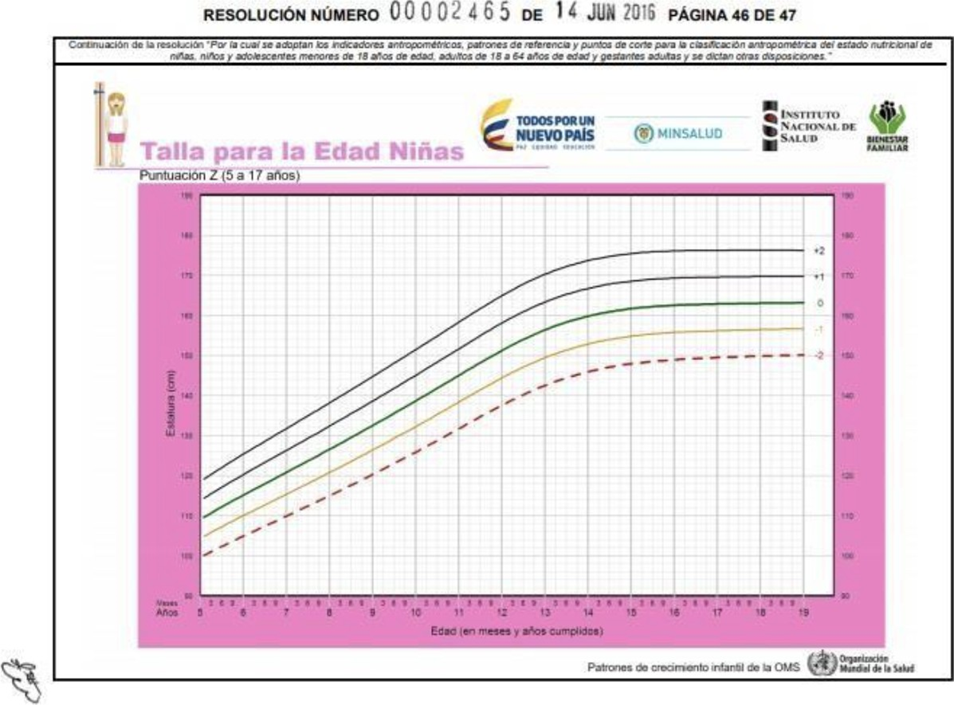
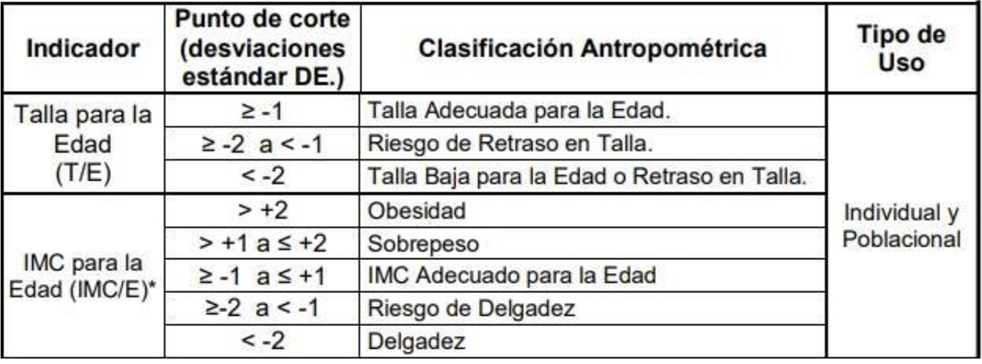
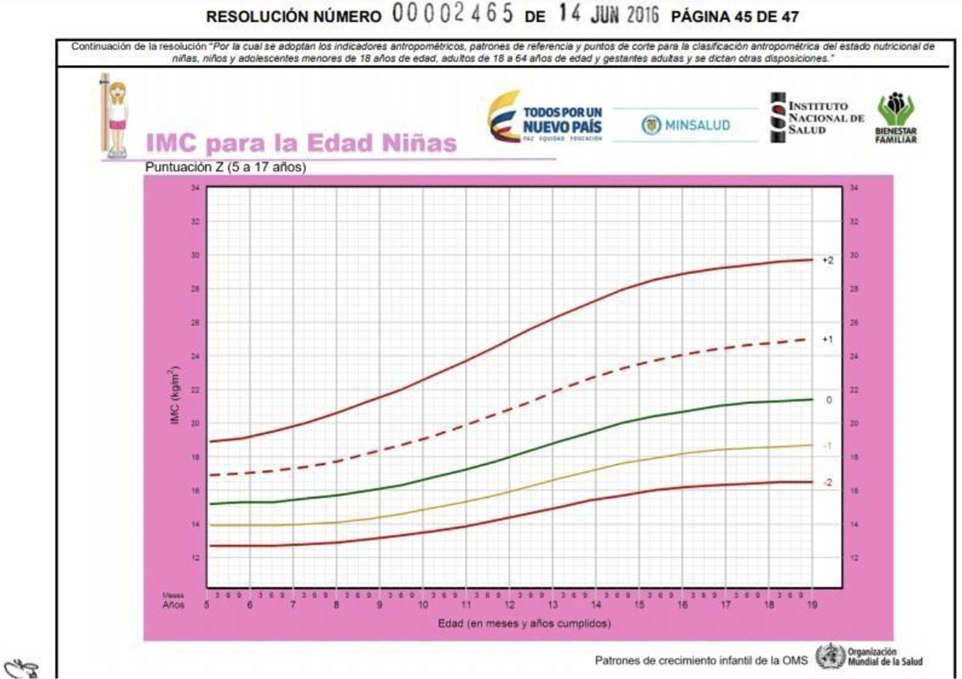
In order to determine the nutritional status of each child and to know if they are below their BMI, Weight for height, Height for age, etc, the graphs of growth patterns in children and adolescents established in Resolution 2,465 of 2016 of the Ministry of Health and Social Protection 9 are used. These graphs allow defining growth channels, which are highlighted with curves. After placing each child within a percentile, we proceed to place them within the Anthropometric Classification Tables of nutritional status according to the age range in which each one is located. It should be noted that the type of use of these indicators can be either Individual or Population. With this procedure, it will be identified how many children are below height- for-age (W/F), weight-for-height (W/L), weight-for- age (W/A) and BMI-for-age (BMI/A) and how many are in the normal range.
The BMI (Body Mass Index), for age, is an indicator that relates, according to age, the total body weight in relation to height. It is obtained by dividing the weight expressed in kilograms by the height expressed in meters squared as shown in equation 1.
The process for determining nutritional status is presented below with the example of an 11-year-old girl with an initial weight of 26 kg and 1.3 m tall. First, her BMI is calculated, which using equation 1 yields a value of 15.30. Next, we proceed to the anthropometric classification by means of the indicators already established by the Ministry of Health for this age group. The first indicator is Height for Age. With the data on height (1.3m) and age (11 years), the individual is located at a point on the WHO growth pattern graph (height for age) for girls between 5 and 17 years of age (see Annex 4). This process shows that the girl is below the red dotted curve, which corresponds to a Z-score of -2. Finally, this result is placed in the Table of anthropometric classification of nutritional status for children and adolescents from 5 to 17 years of age (see annex 5) and it is found that the girl has Low Height for Age or Delayed Height.
The second indicator for children older than 5 years is BMI for age. Following the same logic as above, taking into account the BMI data (15.30) and age (11 years), the girl is located at a point within the WHO growth pattern graph (BMI for age) for girls between 5 and 17 years (see Annex 6). In this case the girl is located at a point between the curves with Z-score of -2 and -1 which within the anthropometric classification chart of nutritional status for children and adolescents from 5 to 17 years of age (see annex 5), yields a result of Thinness Risk.
This same process is applied for each of the 123 children participating in the project and with this anthropometric classification information, initially a characterization of the data is presented. This information is intended to give a general idea of the nutritional profile of the children who entered the program as well as the results of the change in height, weight and BMI disaggregated by age and sex.
For the second stage, the statistical significance of the changes in the weight of the participants will be determined. For the latter, a paired t-test will be used, which is useful to analyze the same set of elements that were measured under two different conditions, for example, the differences in the measurements taken in the same subject before and after a treatment.
Following Purwestri et al. (2012), who used paired t-test to test the nutritional indicators before admission and after discharge for their treatment groups in a similar project, in this work we use the same paired (or "dependent") t-test since we know beforehand that the observations are related to each other, as they are measurements taken on the same subject at different times. In the case of this work, the same children had their weights taken at the beginning and at the end of the complementary feeding project, so it is to be expected that there is a relationship between the weights in kg demonstrated by each child.
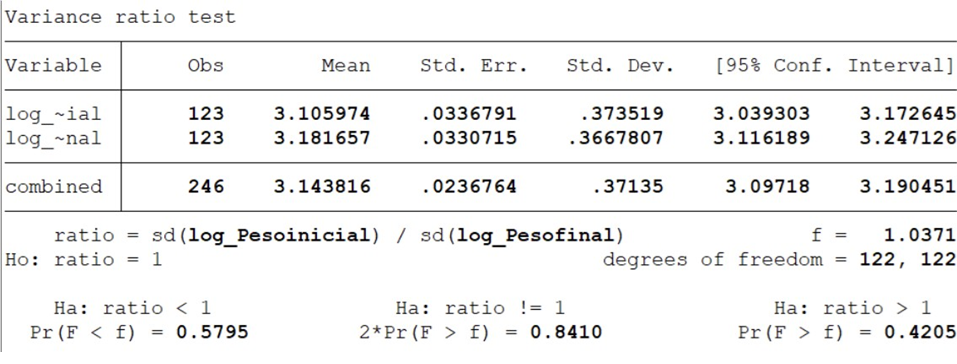
The paired t-test accounts for this. For each beneficiary, we are essentially looking at the differences between the two moments and testing whether or not the mean of these differences equals zero, i.e., whether or not there is significant difference in the measures contemplated. In order to use this test, certain assumptions must be met. These are: The sample must be random, the samples must be paired (dependent on each other) and have a normal distribution or greater than 30. In this case, unlike the independent t-tests, it is not necessary to verify the homogeneity of variance of the samples because it is assumed that the samples will be homogeneous because they are the same individuals. However, the verification of the homogeneity of variances can be found in the annexes (See Annex 2).
At the time of performing the Jarque-Bera normality test (skewness - kurtosis) for each sample (initial weight and final weight), results of non-normality were obtained. However, when this happens, it is possible to resort to a transformation of the data. Therefore, a logarithmic transformation was performed to achieve the normalization of the series. According to Pita (2009), "if the data do not have a normal distribution, one or both variables can be transformed by means of a logarithmic transformation" (p.8). All statistical processing and analysis was performed with Stata version 14.0.
Finally, a brief comparison of the results of the Tearfund supplementary feeding project, in terms of speed of weight gain, with two other similar projects is presented.
Results
From the first part of the analysis, which consisted of classifying the nutritional status of the participants, it was found that a considerable number of children were underweight and underweight. In the second part of the analysis, it can be observed whether the difference in weight between the initial and the final moment of the intervention was statistically significant. And finally, what was the performance of this project in comparison with two other similar complementary feeding programs.
The population of children participating in the project is distributed as showed in Table 1:
Table 1
Distribution by age and gender - Project participants
| Population | Observations | % of total |
|---|---|---|
| Girls ≥ 5 years | 40 | 32,52% |
| Children ≥ 5 years | 62 | 50,41% |
| Girls < 5 years old | 8 | 6,50% |
| Children < 5 years old | 13 | 10,57% |
| Total | 123 | 100,00% |
The largest proportion of the population are boys over 5 years of age, followed by girls over 5 years of age and boys and girls under 5 years of age, respectively.
The anthropometric classification is done following the guidelines of Resolution 2,465 of 2017 of the Ministry of Health and Social Protection mentioned above, which establishes different indicators by age group. For children under 5 years of age - or what we know as early childhood - the indicators Weight for Height - P/T, Height for Age - T/E and Weight for Age - P/E are used to determine the evolution of growth and part of the development of boys and girls; and for children between 5 and 17 years of age the Body Mass Index for age BMI/age and Height for Age are used.
T/E. Unlike the previous group, this one does not include the Weight for Height - W/L indicator, taking into account that the results of the comparison of the WHO standards with the previously used standard of the National Center for Health Statistics - NCHS show that this indicator is very similar to that of the body mass index for age in children from five to nine years of age.
Because the anthropometric analysis uses different indicators for children under and over 5 years of age, the analysis of the results for height, weight and BMI of boys and girls is done separately for the two age groups.
For children under 5 years of age, the following results were obtained:
The results in weight and height gain for this age group were as Table 2 shows:
Table 2
Gain in kilograms and centimeters for children under 5 years of age
| Population | Average gain in Kg | Average gain in cm |
|---|---|---|
| Girls < 5 years old | 1,5625 Kg | 0,01875 |
| Children < 5 years old | 1,1166 Kg | 0,02615 |
| Total average weight gained in children | 1.3 Kg | 0,02245 |
Some important observations with respect to these results were that within this group of children all but one showed an increase in weight. This atypical data -because it was also a decrease of 2.6 kg- was taken out of the data series at the time of averaging weight gain. This particular case could be due to different factors exogenous to the project, such as, for example, an illness of the child that caused him/her to lose that number of kilograms.
On the other hand, in the group of girls, the maximum value of weight gain was 3.1 kg. This was the only girl in the under-five sample who showed a healthy nutritional status from the beginning of the program since she had an adequate score in the three indicators that were calculated: Weight for height P/T, Height for age T/E, Weight for age P/E. Also, this child was the youngest in her sex and age group, she was 2 years old at the time of starting the program.
In addition, the minimum amount of weight gain was 0.6 kg, corresponding to a girl who presented Acute Malnutrition Risk and Global Malnutrition Risk in the indicators of Weight for height P/T and Weight for age P/E respectively.
These two findings are important because they confirm two theories regarding nutritional research: 1. The age of 0 - 2 years is determinant in the early growth of children and is a crucial time for the prevention of nutritional problems in the future. Branca and Ferrari (2002), explain it as follows: "Good infant growth will be ensured by exclusive breastfeeding until the age of 6 months and by providing complementary foods with adequate micronutrient density until the age of 2 years" (Branca and Ferrari, 2002, p.15).
And second, the fact that children with inadequate nutritional status, have more difficulty gaining weight and the impact of feeding programs is usually less when they have an unfavorable nutritional status from the beginning. "After 2 years of age, it is much more difficult to reverse the effects of malnutrition on stunting, and some of the functional deficits may be permanent" (Dewey & Afarwuah, 2008, p.2).
For each child, their gain in kilograms as a proportion of their initial weight was also calculated. The first row, for example, indicates a child's weight gain of 4.38% as a proportion of his or her initial weight (Table 3).
Table 3
Gain in kilograms as a proportion of initial weight- Children under 5 years of age.
Although height data were taken, this work focused on analyzing the results of weight, since, as mentioned above, the main objective of the project was to mitigate the risks that the children of Villa Caracas faced in terms of their nutritional status, focusing specifically on their weight. In addition, it is considered that the intervention time was short (85 days) to observe significant results in height.
This is supported by Tomedi et al. (2012) who obtained similar results in a project that aimed to establish the operational feasibility and effectiveness of using locally available food to prevent malnutrition and improve child growth in Kenyan children. The intervention consisted of making the distribution of a monthly food ration for children aged 6-20 months and group education on appropriate complementary feeding and hygiene was provided for 7 months (a duration even longer than that of the Tearfund project). Tomedi (2012), reported a significant decrease in the prevalence of childhood wasting and underweight, but no positive effect on stunting was observed.
Kennedy (2018), in his literature review and based on the results obtained, suggests that "the largest and longest-term interventions were those that saw the greatest increases in height (or stature), indicating that larger scale approaches are needed to produce significant impact" (Kennedy, E, 2018, p.41).
The following results were obtained for those over 5 years of age:
More than 50% (21 of the 40) of girls over 5 years of age scored below the appropriate level on the BMI-for-age indicator.
16 of the 40 girls over 5 years of age scored below the adequate level in the Height-for- Age indicator.
61% (38 of the 62) of the children older than 5 years scored below the appropriate level on the BMI-for-age indicator.
26 of the 62 children over 5 years of age scored below the adequate level in the Height- for-Age indicator.
Regarding the increase in BMI in the population below the adequate level (Children with Thinness and Thinness Risk), the following results were found (Table 4):
Table 4
BMI-for-age - Children over 5 years old
As can be seen, for boys and girls over 5 years of age, it was observed that more than 60% of them who were below the age-appropriate BMI saw an increase in this index.
At the global level, i.e. including children over and under 5 years of age, the initial and final weight was plotted for each child (Graph 1).
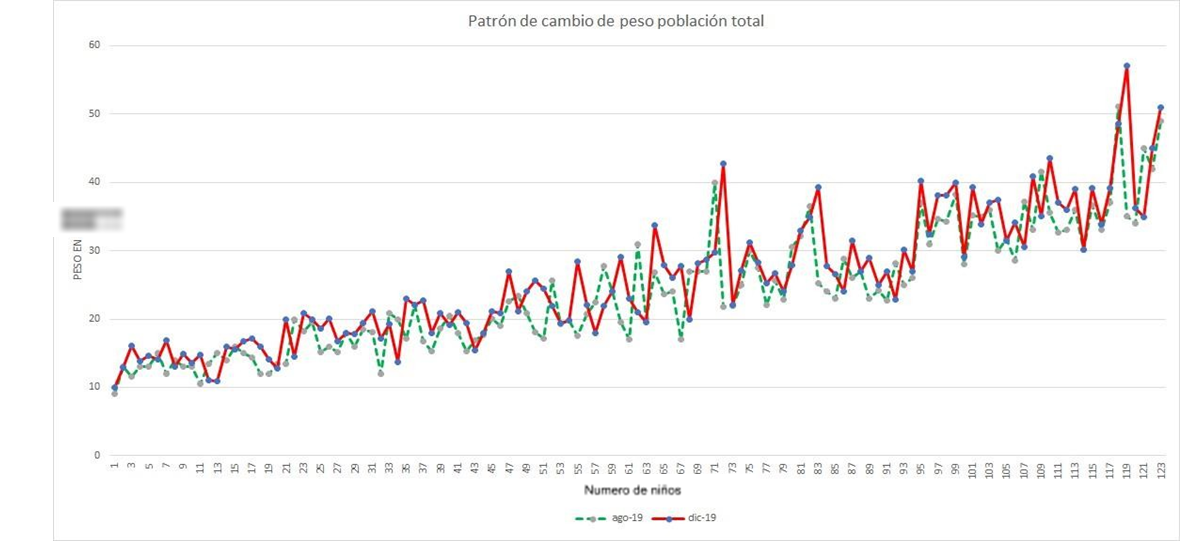
This graph shows how most of the children had an increase in their weight in the period after the initial measurement. This is evidenced by the fact that the points on the red line corresponding to the weight measurements in the month of December at the end of the project tend to be to the right and above the points on the green line.
Significance analysis:
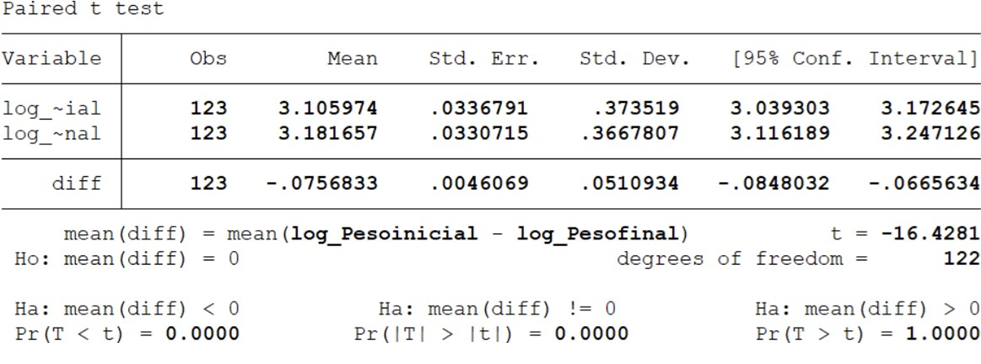
As mentioned above, in order to analyze the results globally, that is, including the population of both age groups, a t-test for paired samples is performed. For this, the following null and alternative hypotheses are established:
mean (diff) = mean (log_initial weight - log_pesofinal)
Ho: mean (diff) = 0
Ha: mean (diff) ≠ 0
Depending on whether the paired t-test yields a p-value less or greater than 0.05, the null hypothesis is rejected or accepted, respectively. The paired samples t-test yielded a p-value of 0.00 (see appendix 3) which allows us to reject the null hypothesis that the means are equal. In this order of ideas, we see that there is evidence of significant differences in the initial weight and final weight of the intervened children.
It is important to mention that, although the change in weight was significant, this cannot be attributed entirely to the effect of the project since the increase in kilograms exhibited may be influenced by factors other than the food they receive from the project, such as the fact that children in this age range are in a stage of growth in which they naturally tend to have constant increases in their weight or that they may even be benefiting from projects of other organizations.
On the other hand, the results in terms of speed of weight gain were also compared with two other similar projects. The rate of weight gain is, according to Patel (2009), a commonly used measure in growth and nutrition research as it summarizes weight gain during a specific time interval, smoothing out the variability inherent in daily weight measurements. It is expressed as grams per kilogram of weight gain per day (g/kg/ day) and is calculated as shown in equation 2.
Conclusions
The food assistance program for Venezuelan migrant children in vulnerable conditions, financed by the NGO Tearfund in the city of Barranquilla, shows evidence in favor of having achieved a significant effect in terms of weight gain of the participating children. However, although most of the children, both older and younger than 5 years old, gain weight and the change is significant, it is less in comparison with other similar projects.
The two examples used for comparison were complementary feeding programs with daily attendance frequency. In both cases, the beneficiaries were children between 6 months and 5 years of age. For this reason, for the project analyzed in this paper, only the rate of weight gain in children under 5 years of age is calculated so that the results can be compared. The first project taken for comparison is described in the research called Iterative Design, Implementation and Evaluation of a Supplemental Feeding Program for Underweight Children Ages 6-59 Months in Western Uganda conducted by Jilcott et al. The project consisted of participating children receiving ready-to-use food of approximately 682 kcal per day for five weeks. Community volunteers and trained staff provided education for caregivers.
The second project is part of the research called Supplementary feeding with locally-produced Ready- to-Use Food (RUF) for mildly wasted children on Nias Island, Indonesia: comparison of daily and weekly program outcomes by Purwestri et al. (2012). This second program also used the distribution of Ready- to-Use Foods (RUF) 10 in the form of fortified cereal / nut / legume based crackers per one-year period.
Regarding the comparison between these three projects, the result for children under 5 years of age for the Tearfund UK project was 1.2 (g/kg/day) while for the Jilcott (2010) project it was 2.5 g/kg/day and Purwestri's (2012) achieved 3.1 g/kg/day.
The difference between this program and others can be explained by several factors. One of them is the duration of the project. The truth is that, in the literature, different results are found regarding nutrition programs. For example, two studies done in Uganda show different results. While Jilcott et al., (2010), observed significant weight gain among targeted children, Ickes, et al. (2017) saw a high proportion of children who remained underweight after the intervention. Both were complementary feeding projects along with caregiver education by trained health workers. "Differences in study duration and sample size could explain the disparity in results" (Kennedy, E, 2018, p.41).
Another reason may be that, as mentioned in the intro- duction, this complementary feeding project provided only one daily food that represented 30% of the daily caloric intake needed and the households had to provide the rest of the food for the children. However, in focus groups, field visits and semi-structured interviews it was found that these families have incomes between $5,000 COP and $10,000 COP daily so many did not have the possibility of having a balanced diet at home. Many mothers stated that the lunch their children received in the dining room was the "main meal" of the day. For this reason, it could be proposed to complement this modality of lunch served with vouchers or cash vouchers for the purchase of food so that the child continues to have good nutrition outside of the community dining room. In addition, for those children who exhibit risk of thinness or malnutrition upon entering the program, reinforcement with infant food supplements may be provided.
In conclusion, positive effects on the children's health can be evidenced, since it helped them to maintain their weight and even increase it, and their health was not deteriorated by the socioeconomic risks to which they were exposed.
Further research should investigate the long-term impacts of varying project durations, the effectiveness of integra- ting food vouchers and/or cash assistance to improve home nutrition, and the potential benefits of providing supplementary food for at-risk children. Practitioners should consider these implications when designing interventions, as understanding the socioeconomic challenges families face is crucial to enhancing nutritional outcomes. By examining these elements, practitioners can develop more robust strategies that address not only immediate nutritional needs but also the broader context of food security and health within vulnerable communities. This holistic approach may ultimately lead to more effective and sustainable interventions in similar settings both in Barranquilla and other cities Latin America.